
By Emily Busch
AHAN President
March 27th, 2005
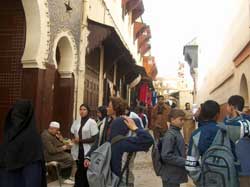
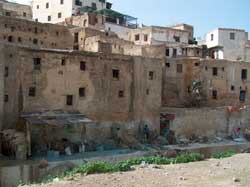
The town of Fez, has a history of over 1000 years. Today the hustle and bustle of life in Fez remains a living testament to its long and colorful past. Fez, the Arabic name for “the town of profits”, is divided into sections, the oldest of which are the medinas or walled cities. To protect from enemies centuries ago, this ancient part of the city is an elaborate labyrinth of shopped lined narrow streets and pathways which lead travelers not only into another world, but another century all together.
The labyrinth of streets (so narrow that it was difficult at times to avoid brushing the shoulder of an oncoming pedestrian as they passed), is organized into a system of souks. Souks are areas specifically designated for the selling of goods and crafts, and one souk would be specifically designated for the weavers, or the tanners, the brass and silversmiths or for the selling of fresh meats, sea foods and vegetables. There were hundreds and hundreds of wonderful tiny shops filled with everything imaginable. The only problem was trying to find a shop against once you had passed it by. There were many I never did find again!
The only other method of transportation besides walking permitted or practical in the medina is by donkey or burros which are used for carrying goods. If a donkey laden with goods is coming your way, the only prudent thing to do, (I learned by experience) is to jump quickly into an open shop or be run down where you stood.
Hurling oneself into a nearby shop I discovered was a great way to find that “perfect” pillow or scarf that might have otherwise gone unnoticed.
In the medina…
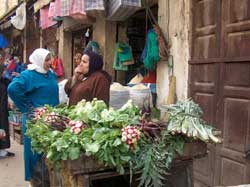
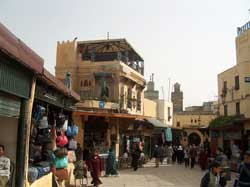
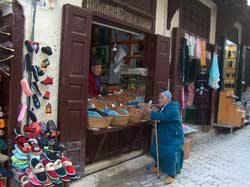
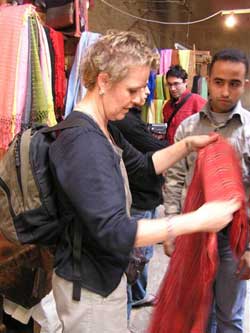
The shopkeepers are always friendly and eager to show you their wares. But a warning, if you find something you like, the BARGAINING begins! Seizing on the opportunity, the shopkeepers would call out a “first price”. Not knowing exactly what the item of interest was suppose to cost, we learned quickly that a good rule of thumb was to counter-offer with about half the amount. From there you work your way down, not up! Even if you think that the shopkeeper couldn’t possibly accept a lower offer it is not time to stop. One more offer, and if it is accepted it is time to call it a sale!
Traveling with me was Mrs. Kazumi Yoshimura, a Nippon Kan student and staff member. We stopped at one shop piled high with the most beautiful Berber rugs and blankets. The shopkeeper became very busy showing us his wares, and one of the rugs caught Kazumi’s eye. After thinking about it for a moment, Kazumi, being the honest person that she is, began to explain to the merchant that she really shouldn’t buy anything for herself, that any extra funds she wanted to save for her daughter. Kazumi had no idea that she was actually bargaining with the keeper as she honestly tried to explain why she couldn’t buy the rug. The shopkeeper however thought she was bargaining and kept lowering the price! Finally he said “okay, okay, last price…for your kid’s sake”. Kazumi looked a little startled as she realized that she had actually bargained very successfully for the rug she ended up purchasing for substantially less that the “first price”. From that moment on, Kazumi became a great bargainer, and ended up doing much of the negotiating for all of us!
First it is important to experience the culture…
-
- before…
-
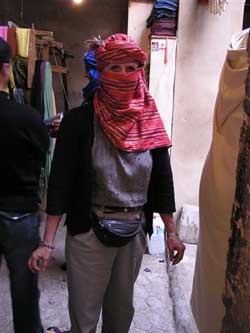
- after…
The medina was a fascinating world, and as ancient as it seemed, it was very clean and orderly. I still have trouble believing that out of the total current population of Fez at 320,000 people, over _ of the population live in this medina and the “new medina” nearby.
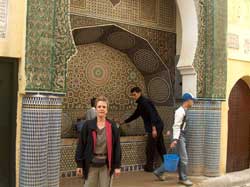
At the heart of the medina is a centuries old mosque and theological university. Near the mosque were many tiled fountains where families and craftsmen alike came to fetch their daily water. Echoing down the walled pathways were the sounds of children reading from the Koran in schools tucked out of sight. Every turn brought an image timeless in its humanity. It was a world behind walls and behind veils, but as I began to learn about this culture, especially from the women I met in this country, a glimpse of a deep culture emerged.
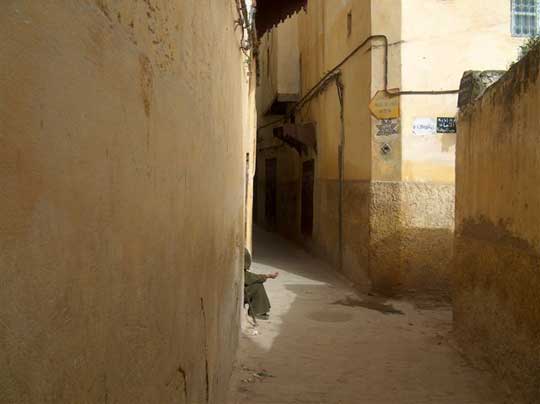
Deep in the medina.
We arrived in the city of Casablanca at 6:30 am. Mrs. Teruyo Sanyo had driven an hour and a half from the city of Rabat to meet us at the airport. Teruyo-san is a friend of Mrs. Nanayo Sasaya who originally asked Homma Sensei to visit Morocco and coordinated our visit. Mrs. Sasaya, from Japan is an active member of the World Peace Women’s’ Association and recently spent three years in Morocco as a peace volunteer.
It was Teruyo-san who acted as host for our week in Morocco. Teryo-san is also from Japan, but married a man from Morocco and has lived in Morocco for over twenty five years. She has four children, and she and her husband run a busy Asian restaurant named the Hong Kong Café. Her name Teruyo is difficult to pronounce in Arabic, so she is nicknamed “Churia”. At first sight, it was like meeting a friend we had known forever.
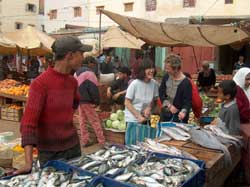
Teruyo-san and Emily Busch shopping
in the local markets.
We met Homma Sensei in Rabat, where he had journeyed from a week long trip in Italy. Teruyo-san’s family restaurant, the Hong Kong Café, became our base of operations. The restaurant was located in a busy retail center of Rabat, and not only was the food great, but the access to local points of interest and the train station to Fez and other cities was close by. During our stay, Teruyo-san took care of us like family.
One unforgettable experience we had with Teruyo-san was to go shopping with her for the restaurant at the local farmers market in Rabat. All of the vegetable venders, butchers, fishermen and craftsmen knew her by sight, and called her name “Churia, Churia” as we entered the market. She was a tough shopper, and not the lease bit intimidated by the local merchants. She bantered easily in Arabic and walked away more than once to ensure she got the “last price” she was looking for. She was very at home in this Moroccan culture and blended easily into the color and excitement of the market. I thought as I watched her what a journey her life must have been, to have traveled so far from her home country and taken on the customs, culture, language, religion and other practices of this country so successfully. The fact that she has raised four kids here would be quite an accomplishment for anyone, and a testimony to her resilience and inner wisdom. Even with the support of her husband, it is a lot to accomplish so far from home for so long.
Today in Morocco, some of the traditions, rights and roles of the past are changing; especially for women. Women today in the more urban areas of Morocco are taking places in business and government and taking on greater roles in education and policy making. In the cities of Rabat and Casablanca not all women covered their hair with a turban, and most wore Western styled clothing. The styling was still modest, and I saw very few skirts, but I did notice a great difference in these modern cities than in smaller towns and villages. In Rabat and Casablanca, Western music could be heard from time to time, and I did see an American fast food chain or two. One step out of the cities however, not only was it stepping into a foreign land, but it was like stepping back into another century.
As I learned more about Morocco where the contrasts between old and new were so vivid, I thought again of Teruyo-san, and the strong spirit she must have to be able to raise four children, argue with vegetable vendors, run a restaurant and be happy in this land so different than her own.
Teruyo-san has earned her 1st degree black belt certification in Shotokan Karate in Rabat, and she has practiced Aikido in Morocco as well. One might think that it might be her martial art training that has made her spirit strong. I think it is the opposite. I think it is because her spirit is so strong that she has accomplished so much and has earned her black belt degree. I bet she is a little wildcat in Karate class! Unlike a foreign businessman or government worker stationed in Morocco for a year or two, Teruyo-san is a native born Japanese-Moroccan, and a diplomat with tremendous talents at bridging the relationship between these two countries.
Teruyo-san accompanied us as we moved on to Casablanca where we made our residence in a hotel near the medina arranged for us by the Moroccan Aikido Association. The hotel was classic, with lots of white tile and hardwoods. The rooms were big, and the hallways and staircases wide and sweeping. I kept expecting to meet Humphrey Bogart on the stairs!
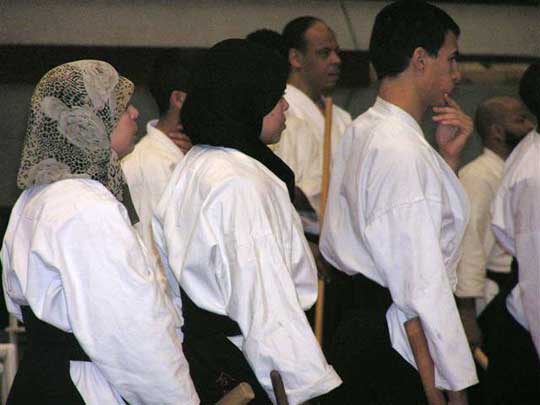
Practice that evening was held in a large sports arena and was attended by about 150 students. Five women attended that evening which compared to the number of women who attend practice in the United States, the number was quite low. Considering the history and culture of Morocco however, five women students was a good number, and I enjoyed practicing with them. They all were very skilled and practiced quite well. After practice I asked one of our hosts about women practicing Aikido in Morocco and was told that although women were not usually barred from practice, it was not yet a fully accepted practice; that it was still early in the development of women and Aikido in Morocco. The lifestyle in Morocco for most women, I was told, still focused mainly in the home and that this strict lifestyle especially once they were married with children made it a very difficult to pursue outside interests. I learned that some dojos still do not allow women to practice there and others hold separate classes for women. These rules applied to groups that held stricter religious believes and adhered strictly to custom and tradition. Thinking about it, I had noticed that custom seemed to dictate the very distinct and separate roles for men and women here, so separately held classes made sense in accordance with other aspects of their lives.
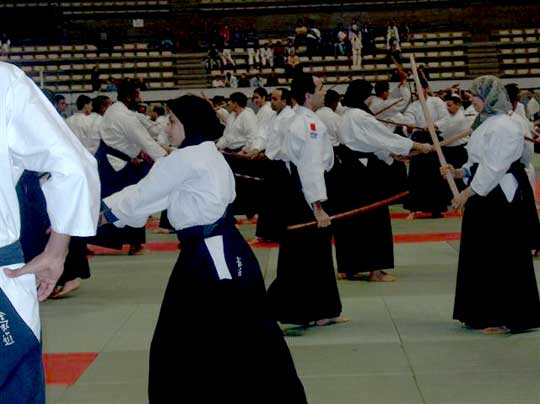
On our last night in Morocco, we were invited to Alaoui M’berak Sensei’s home for dinner. He lived inside the medina in Casablanca, and we were escorted to his home through another maze of winding narrow streets by a group of his senior students. I am absolutely certain that if we were supposed to find his home by ourselves we never would have found it. As we walked deeper and deeper into the medina, a thought did cross my mind about ever being able to find our way out. When we arrived, we climbed a narrow staircase to his home. I had no idea what to expect, but was fascinated to have the chance to visit a home inside the medina.
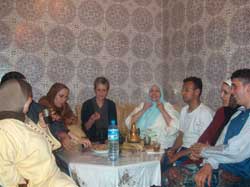
The narrow staircase led us to what I can only think of as a palace! Alaoui Sensei and his wife were there to greet us as we looked around in awe at our surroundings. The walls and floors were laid with beautiful Moroccan tiles. There were crystal chandeliers hanging from the ceiling and rich carpets on the floors. The living room was lined on all sides with a continuous bench couch decorated elaborately with matching pillows. Soon about thirty people had joined us for this gathering and everyone sat comfortably talking and laughing over mint tea, dates and nuts.
The women and children were seated at one end of the room while the men sat at the other. Kazumi and I joined Homma Sensei and the men for the first part of the meal. We were served vegetable couscous out of gigantic dishes placed on low tables at both ends of the room. Everyone ate from the giant dishes, very skillfully rolling the couscous into bite sized balls which they popped into their mouths with ease.
After the main course was finished, Kazumi and I went to the other end of the room to join the women and children for tea and fruits. Despite a serious lack of command of either Arabic or French on my part, we did manage to communicate quite well, and I found the women to be quite wise and strong spirited with a great sense of humor. The conversation focused mainly on family, children, weddings, fashion and jewelry. They asked me how many children I had, and were a little perplexed to hear that I had no children of my own; that my only “son” was actually a puppy named Genbei!
Alaoui Sensei’s wife brought out the photo album of their daughter’s wedding and we all had a great time pouring over the photos together. Most of the women and children there that evening were in the wedding photos, so it was fun trying to match the faces in the photos with the faces surrounding us in the room.
photo 13 4978.jpg Welcomed by the entire family!
At some point it dawned on me that two of the women in the photos, and also in the room were both wives of Alaoui Sensei. I must have had quite a quizzical look on my face, because everyone burst out laughing! I was very impressed with the fact that everyone seemed to get along so well and seemed very comfortable with their positions. Everyone seemed so happy! Knowing that this custom would not be well accepted in the United States did not matter here. Sitting closely with this large extended family eating couscous, drinking tea, laughing and talking together, it seemed perfectly natural…I definitely was a long way from home.
As Vice President of Nippon Kan and President of AHAN, I have had many opportunities to visit other lands and experience other cultures. In Japan, Nippon Kan has had a cross-cultural exchange program with a small village in Northern Honshu called Higashi Naruse Village. Every year in May, the village holds a spring festival in hopes of a successful rice planting season. I have been to this festival five times on cross-cultural tours with Nippon Kan and have spent a great deal of time in family homes for this festival. A Tradition in Higashi Naruse Village dictates that village residents to go home to home stopping to visit, celebrate and otherwise “eat, drink and be merry”. Each family presents an incredible array of food and drink for their guests, and the hospitality is always incredible. On these tours, it never fails for other Americans to ask me, “Where are the women, why are they not at the party”?
At each home, long tables are set up in the center of the house and covered end to end with foods and beverage. Lined up on both sides of the table would be twenty to thirty men, enjoying the festival foods, each others company, and the hopeful mood of the planting season to come. Looking at the scene at hand, the question was not unreasonable. This was a special celebration, and it would seem that the women and children should be included.
I had this same question the first couple of times I visited Higashi Naruse Village, and from an American perspective, it seemed to me a little “repressive” to say the least. Over time, I grew to know many people in the village and became more familiar with their lives and their culture, and the question seemed to answer itself.
The culture and traditions in Higashi Naruse are centuries old, and while a satellite dish can be seen on the rooftops of many homes, the Village office has an official website, and a rock and roll band plays at some of the village functions, many of Higashi Naruse’s customs have not been changed by modern influences. The village is still isolated geographically by the ranges of mountains that surround it, and in so many ways these mountains have protected the purity and the innocence and the wonderful nature of these people.
The roles in their society are still separate for men and women in ways that have disappeared in more modern parts of Japan and other parts of the world. While women do work in the Village offices, the role of the woman, (and the man) in the home remain as it has for hundreds of years.
At these celebrations I soon discovered that the women could be found in the kitchen, (having a party of their own mind you) as they worked to keep the endless plates of Japanese delicacies flowing towards the party outside. Like I experienced in Morocco, this arrangement while not the environment that I grew up in, is accepted and natural here. If you planted the women at the table outside to talk about local politics, future village plans or farming conditions, I don’t think anyone would feel very comfortable with the arrangement!
When I was a college student, I spent a year in Japan and attended Jochi (Sophia) University in Tokyo. I also participated in independent study projects in very rural parts of Southern Japan. After my year spent in Japan, I traveled through Southeast Asia with friends for a year on a budget of $1000.00. Obviously it was a low budget tour of the countries we visited, which we experienced from a very “local” perspective.
My travels have taught me not to judge. That what is right for some is not right for others at different times in their own cultural development. I have never personally experienced any cruelty or the feeling of severe oppression in my travels even though by American standards some of what I have described in this article might be termed as such. I believe in the human rights of women, of all people, and like to see education and health and freedom developed in places where it has not been. It was my hope on this trip to Morocco that Aikido would be a new wind in Morocco for the women there, but a gentle one that rose from their own culture and in their own time.
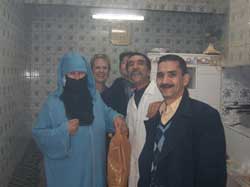
Morocco remains a men’s society today, but the women I met in Morocco had a wonderful strength and wisdom that I could feel. I practiced Aikido with women in Morocco, and whether their hair was covered or they chose not to, there was a power within them. I met one woman in Casablanca who wore no scarf, braided her hair in cornrows and rode a motor scooter. She was the exception however, a little ahead of her time!
Sometimes if we measure the traditions, economic standards, religion and lifestyles of others by the way we were raised, it can lead to unfair judgments. To try to force our standards on others is not an approach that will be readily accepted. On this trip I was able to meet many women from Morocco. Some of those women were covered except for their eyes, and in the little time I was able to spend there, I could not possibly learn the totality of their experience. I did experience the kindness and wisdom in those eyes, and experienced the kindness and hospitality that was extended towards us. Experiencing openly the heart of another country affords a communication that goes beyond language; it is the heart to heart communication of respect.
I learned on this trip that many of the preconceived ideas that I had held were just that, preconceived ideas based on distant information. Visiting the ancient Islamic culture of Morocco was a revelation to me, and very eye opening.
In this land of many different customs and traditions I want to that Alaoui M’berak Sensei for his wisdom, his kindness and his understanding of Aikido, past present and future. Through Aikido, I hope a new wind comes to the women of Morocco.
Sincere thanks to all of the people I had the opportunity to meet in Morocco who made this experience unforgettable. Hope to see you again soon!
Related articles:
A Friend for Life; Women I met in Morocco.
Nippon Kan Vice President, AHAN President Visits Morocco.
Preserving Our Traditional Heritage.